
Stainless Steel for Semiconductor Manufacturing
Stainless steel is used throughout semiconductor manufacturing facilities, in process cooling water piping, utility lines, cleanroom equipment, exhaust ductwork and high-purity gas systems. Each of these systems has different requirements, so the right grade and product depend on where the material will be installed.
Kentzu Steel has supplied stainless steel pipes, fittings, flanges, sheets, plates and bars to industrial customers in Malaysia and across the ASEAN region since 1983.
Where Stainless Steel Is Used in a Semiconductor Plant
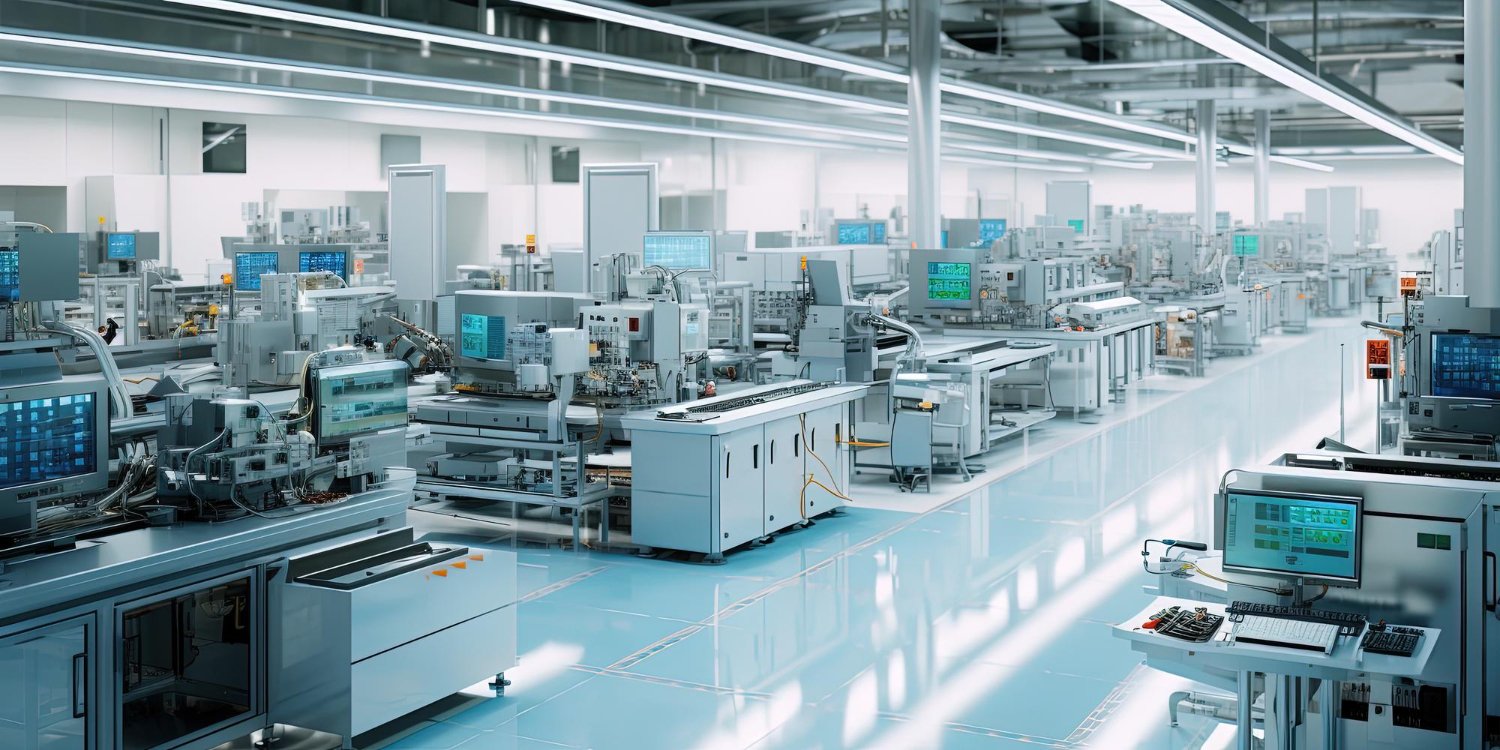
The table below summarises the main systems and what drives material selection in each.
| System | Purpose | Typical Stainless Steel Products | Main Selection Factors |
|---|---|---|---|
| Process cooling water (PCW) | Removes heat from production tools | Welded or seamless pipe, butt-weld fittings, flanges | Water chemistry, chloride level, pressure |
| Facility utilities | Compressed dry air, vacuum, treated water | Pipe, fittings, flanges | Fluid, operating conditions, piping code |
| Cleanroom equipment and structures | Frames, panels, racks, workstations | Sheet, plate, hollow sections, bar | Surface finish, fabrication quality, cleanability |
| Exhaust ductwork | Carries process exhaust to treatment | Sheet for bare or coated duct | Exhaust chemistry, fire safety requirements |
| High-purity gas lines | Delivers process gases to tools | Electropolished 316L UHP tubing | Purity class, internal surface, SEMI standards |
Process Cooling Water (PCW)
PCW systems circulate treated water through production tools and heat exchangers to remove heat. Stainless steel is widely used for PCW piping because of its corrosion resistance and weldability. Some plants use plastic piping such as PVC or polypropylene for parts of the system, so confirm the material specification early.
For treated water with a low chloride content, 304L is often adequate. 316L is the better choice where chloride levels are higher, where water treatment is less tightly controlled, or where pipework is exposed to coastal air. The water analysis should guide the decision.
Kentzu Steel supplies welded and seamless pipes, together with butt-weld fittings and flanges, for PCW and other industrial piping.
Facility Utilities
Compressed dry air, vacuum and treated-water lines use stainless steel where its corrosion resistance or cleanliness justifies the cost over carbon steel or copper.
Most utility lines do not require process-gas purity. Some, such as clean dry air supplied to production tools, have their own cleanliness requirements. The grade, pipe schedule and fittings are determined by the fluid, the operating pressure and temperature, and the applicable piping code.
Cleanroom Equipment and Support Structures
Equipment fabricators use stainless steel sheet, plate, hollow sections and bar to build frames, machine covers, workstations, racks and service panels. In a cleanroom, three factors matter as much as the grade:
- Surface finish. Smooth finishes such as 2B or BA (bright annealed) are easier to clean than heavily brushed finishes.
- Joint design. Continuous welds and fewer crevices leave less space for particles and cleaning residue to collect.
- Iron contamination. Grinding discs, brushes or clamps previously used on carbon steel can leave iron particles that later appear as rust spots. Use dedicated stainless steel tooling and passivate after fabrication.
A mill finish alone does not make a component cleanroom-ready. The finished part must meet the plant's cleanliness specification.
Exhaust Ductwork
Solvent exhaust ductwork is commonly made of stainless steel, as building codes and insurers favour non-combustible duct for flammable vapours.
Acid exhaust is more corrosive. Bare 304L or 316L can corrode in wet, acidic conditions, so many plants use fluoropolymer-coated stainless steel or FM-approved plastic duct for acid service. Confirm the exhaust chemistry, temperature and condensation risk before selecting a material.
High-Purity Gas Lines
Specialty and process gas lines use ultra-high-purity (UHP) tubing. Although it is often made from 316L, UHP tubing is a different product from industrial pipe, as explained in the next section.
Industrial Pipe vs Ultra-High-Purity Tubing
Industrial stainless steel pipe and UHP tubing may both be specified as 316L, but they are made, finished and supplied to different standards. Treating them as interchangeable is a common procurement error.
| Industrial Stainless Steel Pipe | Ultra-High-Purity (UHP) Tubing | |
|---|---|---|
| Typical service | PCW, facility utilities, general process piping | Specialty gases and high-purity process lines |
| Sizing | Nominal pipe size (NPS) and schedule | Outside diameter (OD), commonly 1/4", 3/8" and 1/2" |
| Product standard | ASTM A312 | ASTM A269 tubing meeting SEMI F20 (material), SEMI F19 (surface) and SEMI F17 (electropolished tubing) |
| Internal surface | Mill finish | Electropolished, commonly Ra 0.25 µm or better |
| Joining | Butt welding, flanges | Orbital welding under controlled purge, face-seal fittings |
| Delivery condition | Standard industrial packing | Cleaned, capped and bagged in a cleanroom |
Other Points to Note
Ultrapure water and many chemical distribution lines use polymer piping such as PVDF rather than stainless steel.
Kentzu Steel's published pipe range is industrial ASTM A312 pipe, intended for PCW and utility services rather than UHP gas lines.
304L or 316L?
304L and 316L are low-carbon austenitic stainless steels. Their carbon content is limited to 0.030% to 0.035%, depending on the product standard, which reduces the risk of sensitisation during welding. This makes both grades suitable for welded piping and fabrication.
The main difference is molybdenum. 316L contains 2% to 3% molybdenum, which improves its resistance to pitting and crevice corrosion in chloride environments.
| 304L | 316L | |
|---|---|---|
| Molybdenum | Not added | 2% to 3% |
| Chloride resistance | Good in mild, low-chloride conditions | Better in chloride-bearing water and coastal air |
| Typical semiconductor uses | Indoor utilities, equipment frames, panels, general fabrication | PCW with higher chlorides, outdoor or coastal exposure, more demanding equipment |
| Relative cost | Lower | Higher, depending on nickel and molybdenum prices |
When to Specify 316L
Specify 316L when any of the following applies:
- The water analysis shows significant chloride content.
- The pipework or structure is outdoors, particularly near the coast.
- Cleaning or process chemicals contain chlorides.
- The project specification requires it.
In other cases, 304L is usually the more economical choice.
316L does not make a product suitable for high-purity service. Surface finish, cleanliness and documentation are separate requirements.
For a wider comparison, read our guide: Stainless Steel 304 vs 316: Differences, Uses & Which One Should You Choose?
Considerations for Semiconductor Plants in Malaysia
Malaysia holds about 13% of the global market for semiconductor assembly, test and packaging, according to MIDA. The industry is concentrated in Penang, Kulim and the Klang Valley, and front-end wafer fabs also operate in the country, such as X-FAB in Kuching.
Back-end and front-end plants have different material requirements, and purity requirements also vary between systems within the same plant. Confirm the requirement for each system before selecting a grade or product.
Location also affects grade selection. Plants near the coast, including many in Penang, are exposed to airborne chlorides from the sea. In these conditions, 316L is preferred for exposed outdoor pipework, pipe supports and external equipment, as 304L can develop surface staining or pitting over time.
Stainless Steel Products for Semiconductor Facility Projects
Kentzu Steel supplies the following stainless steel products for facility utilities, equipment fabrication and support structures.
| Product | Standard and Range | Typical Use in Semiconductor Facilities |
|---|---|---|
| Welded & Seamless Pipes | ASTM A312 / ASME SA312 | PCW and facility utility piping |
| Butt Weld Fittings | ASTM A403, Sch 10S / 40S, elbows up to 12", tees up to 8" | Elbows, tees, reducers and stub ends for utility piping |
| Forging Flanges | ASTM A182, 1/2" to 12", Class 150 / 10K / PN16 | Flanged connections at equipment, valves and tie-ins |
| Sheets & Plates | ASTM A240 / ASME SA240 | Equipment panels, covers, enclosures and ductwork fabrication |
| Hollow Sections | ASTM A554 | Equipment frames, racks and support structures |
| Round Bars & Shafts | ASTM A276 / ASME SA479 | Machined parts, brackets and shafts |
Stainless Steel Pipe Range
| Specification | Range |
|---|---|
| Grades | 304 / 304L / 316 / 316L |
| Types | Welded and seamless |
| Standard | ASTM A312 / ASME SA312 |
| Nominal pipe sizes | 1/2" to 16" |
| Schedules | Sch 10S / Sch 40S / Sch 80S |
| Standard length | 6 metres |
The correct schedule depends on the design pressure, temperature and applicable piping code. Fittings are listed up to 12" (tees up to 8") and flanges up to 12", so please confirm availability for larger lines.
Explore our stainless steel products
What to Include in Your Enquiry
A complete enquiry allows us to prepare an accurate quotation without repeated clarification. Please include:
For example, welded pipe to ASTM A312 or plate to ASTM A240.
State 304, 304L, 316 or 316L exactly as specified. If the specification calls for 304L and 304 is offered, ask whether the material is dual-certified 304/304L.
For pipe, give the NPS, schedule and length. For sheet and plate, give the thickness, width, length and finish. State whether each size is nominal or OD.
State any passivation, electropolishing or surface finish requirement. These are not included with standard material unless specified.
State whether your quality assurance requires mill test certificates, heat-number traceability or other inspection records.
For large projects, share the delivery schedule and site location so stock and delivery can be planned.
Why Choose Kentzu Steel for Semiconductor Projects
Semiconductor facility projects need the right material in the right specification, delivered to schedule. This is how Kentzu Steel supports engineering contractors, equipment fabricators and procurement teams.
Over four decades of stainless steel experience
Established in 1983, Kentzu Steel has more than 40 years of experience in stainless steel trading, sourcing and industrial supply, across a wide range of product forms, grades and specifications.
One source for piping and fabrication materials
A semiconductor package often needs utility piping and equipment materials at the same time. We supply pipes, fittings, flanges, sheets, plates, hollow sections and bars, so contractors can coordinate them through one supplier.
Pipes and fittings made within our group
Our subsidiary Kanzen Tetsu Sdn Bhd manufactures stainless steel pipes, and S.P. United Industry Sdn Bhd manufactures stainless steel fittings. Both are ISO certified.
Support for customised requirements
Where standard products do not fully meet a project's needs, we support customised requirements based on the required sizes, specifications and intended application. Share your grade, dimensions, finish, standards and drawings for assessment.
Experience across traditional and technology industries
We supply industries including oil and gas, petrochemical processing, water treatment, semiconductor manufacturing and data centre cooling systems. See the industries we serve.
Supply across Malaysia and ASEAN
We serve customers across Malaysia, East Malaysia and the ASEAN region. Kentzu Steel (Penang) Sdn Bhd serves the northern region, home to the Penang and Kulim semiconductor clusters. Kentzu Steel is also registered with the Ministry of Finance Malaysia for government-related projects.
Frequently Asked Questions
What stainless steel grades are used in semiconductor manufacturing?
304L and 316L are widely used in semiconductor facilities. 304L suits indoor utilities and general fabrication. 316L is preferred where chlorides or coastal exposure are a concern. High-purity process lines use 316L tubing manufactured and finished to semiconductor-specific standards.
Is 316L suitable for every semiconductor piping system?
No. Suitability depends on the fluid, temperature, pressure and purity requirement. Acid exhaust often requires coated or non-metallic duct, and ultrapure water lines frequently use polymer piping.
Can standard stainless steel pipe be used for semiconductor gas lines?
Not for high-purity or ultra-high-purity gases. These lines require electropolished, cleaned and qualified tubing that meets standards such as SEMI F17, F19 and F20. Standard ASTM A312 pipe is suited to utility services such as PCW.
Should I choose welded or seamless pipe?
Follow the piping specification. Welded pipe is widely used for utility services and is generally more economical. Seamless pipe is often specified for higher-pressure duty. Kentzu Steel supplies both, so please contact us to confirm availability for your sizes and schedules.
What information should I provide for a quotation?
Provide the product, standard, grade, dimensions, finish, quantity, documentation requirements and delivery location, including any passivation or certification requirements.
Request a Quotation
Sourcing stainless steel for a semiconductor project? Send us your enquiry and our team will be glad to help. Even a rough list is a good place to start.